
Edaphosaurus pogonias
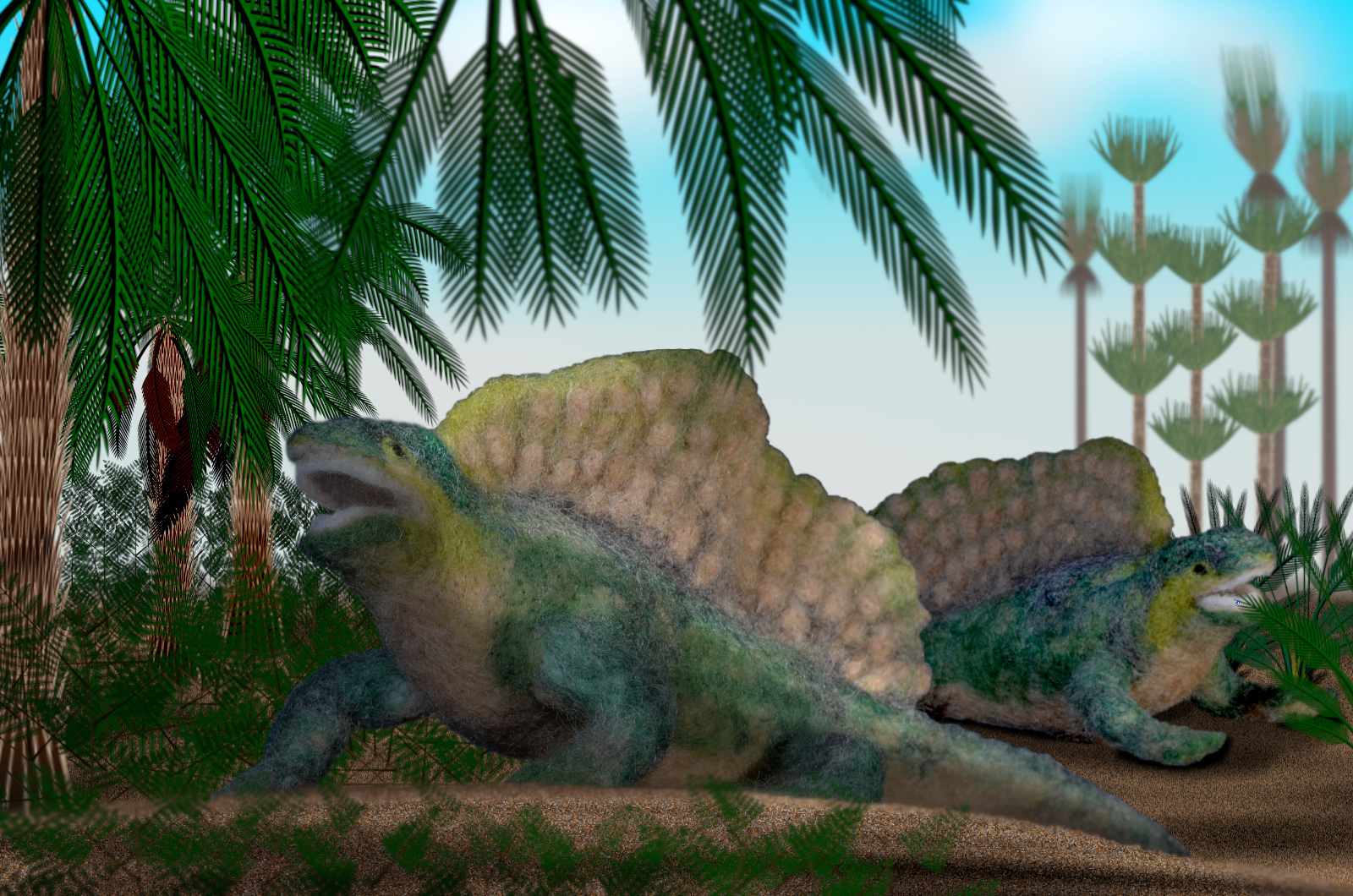
Edaphosaurus pogonias is an extinct terrestrial vertebrate that lived from the Late Carboniferous to the Permian 1), and its groups are found in North America and Europe 1). As well as the Permian Dimetrodon, it is well-known for its large sail-like structure on its back 1), 3).
E. pogonias was approximately 2.0 metres long (estimated from the TEXT-FIG.2 on Huttenlocker(2011) 3)).
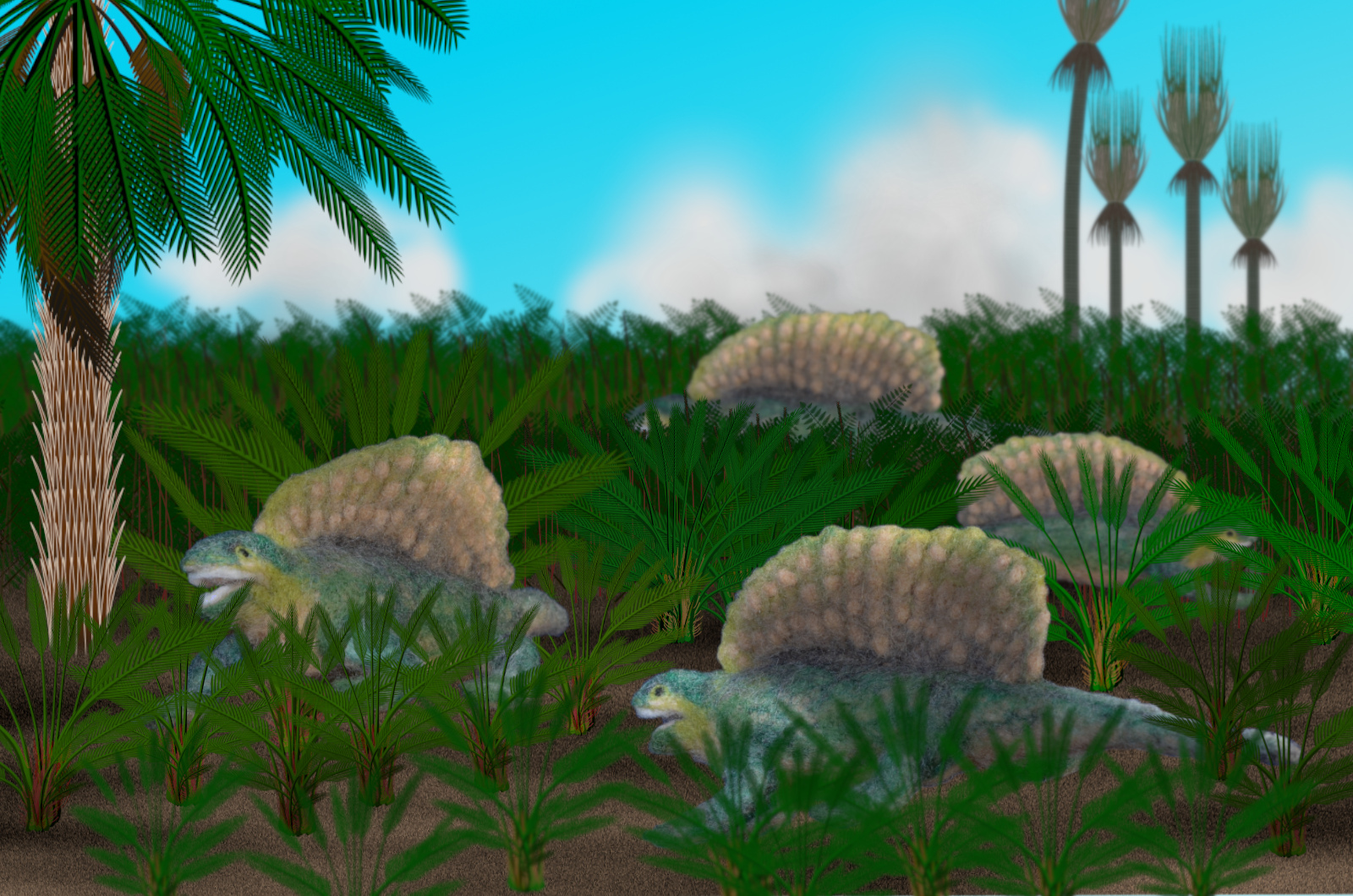
The distinctive back sail is supported by extremely elongated vertebral neural spines 1), 3). However, comparing the the neural spines of Edaphosaurus with those of Dimetrodon, the former have lateral tubercles on their both side 1).
Historically, it had been believed that the sail had a thermoregulatory function, but the histlogical properties or growth patterns of the sails have called this function into question. On the contrary, some have argued that it served as display, fat storage organ, or used as individual recognition 3).
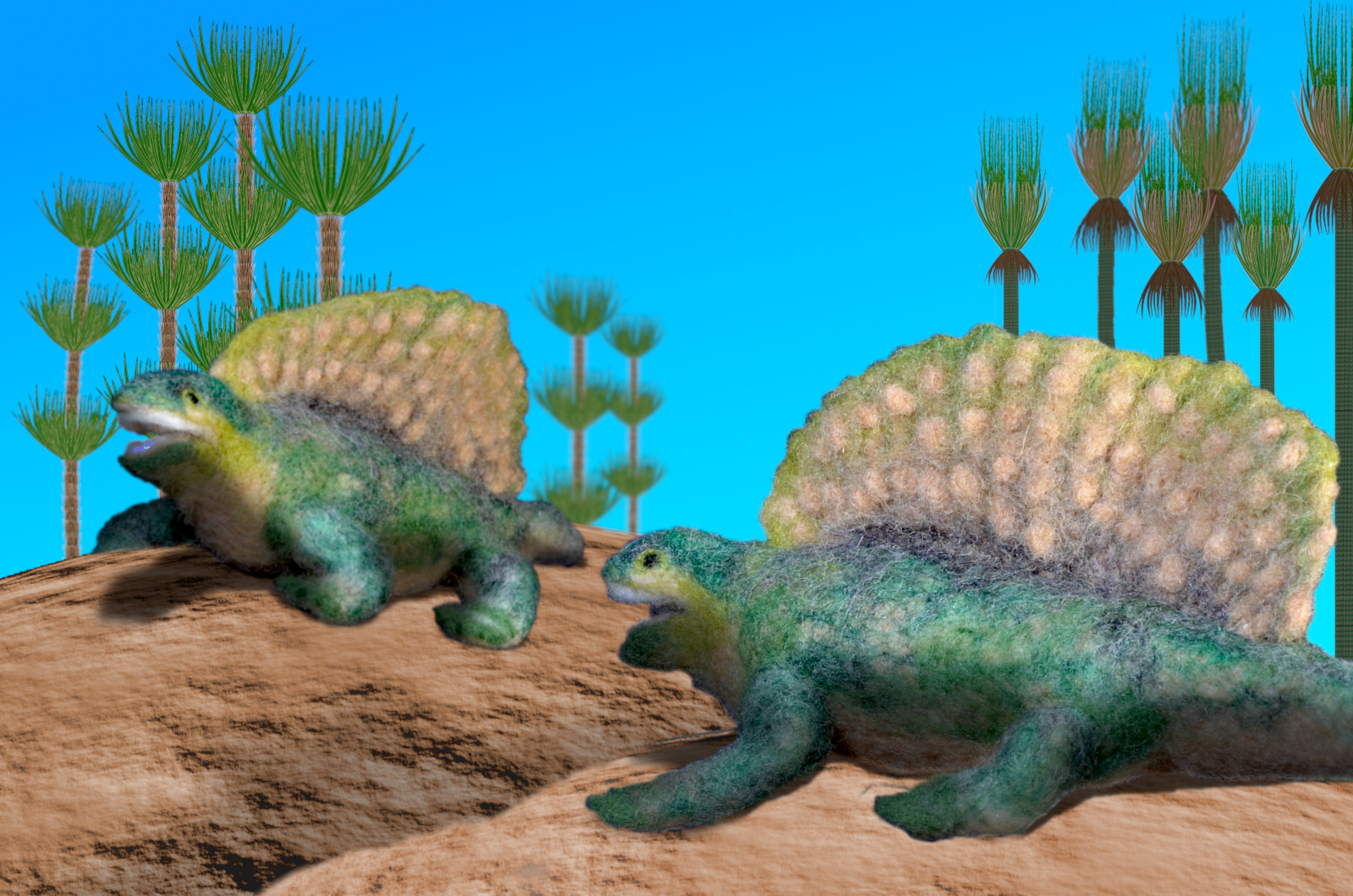
The combination of a large broader trunk and small head would indicate Edaphosaurus was a herbivore 4). Edaphosaurus would have cut off the plants to some pieces with the the marginal teeth on the anterior of jaws, and crushed the pieces of plants with rubbing the inner teeth plates during occlusion 4). It is believed that they would have digested and absorbed fibrous plants using fermentation of endosymbionts in their bulk abdomen 4).
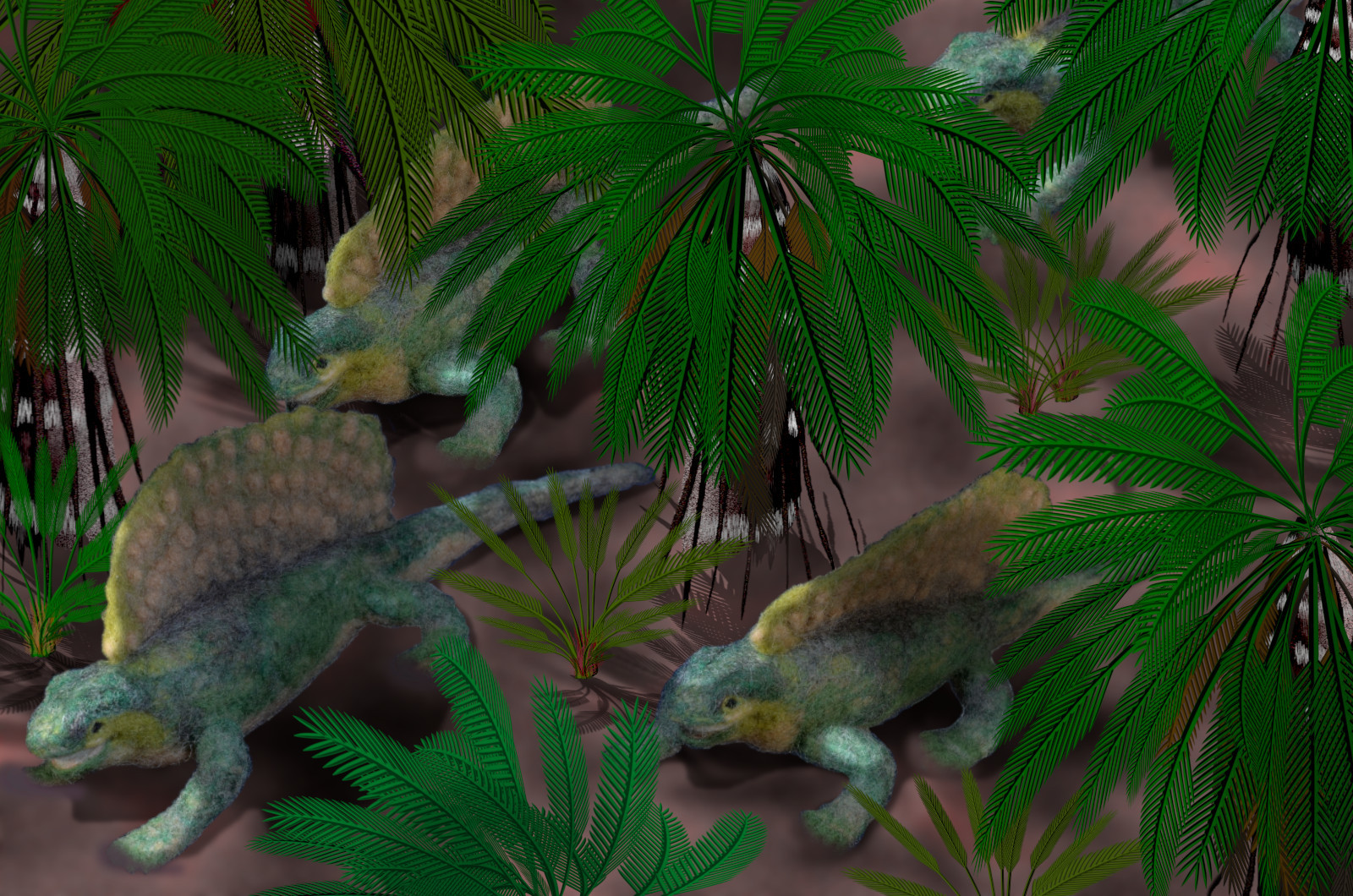
Harbivore Edaphosaurus and carnivorus Dimetrodon are placed on basal synapsids group, which include Mammals 3). Although their appearance are resemble to reptiles, they are more closely related to mammals than to reptiles 2). They are characterized by sail on their backs, but their structures have developed independently, that is, convergent evolution 2), 3).
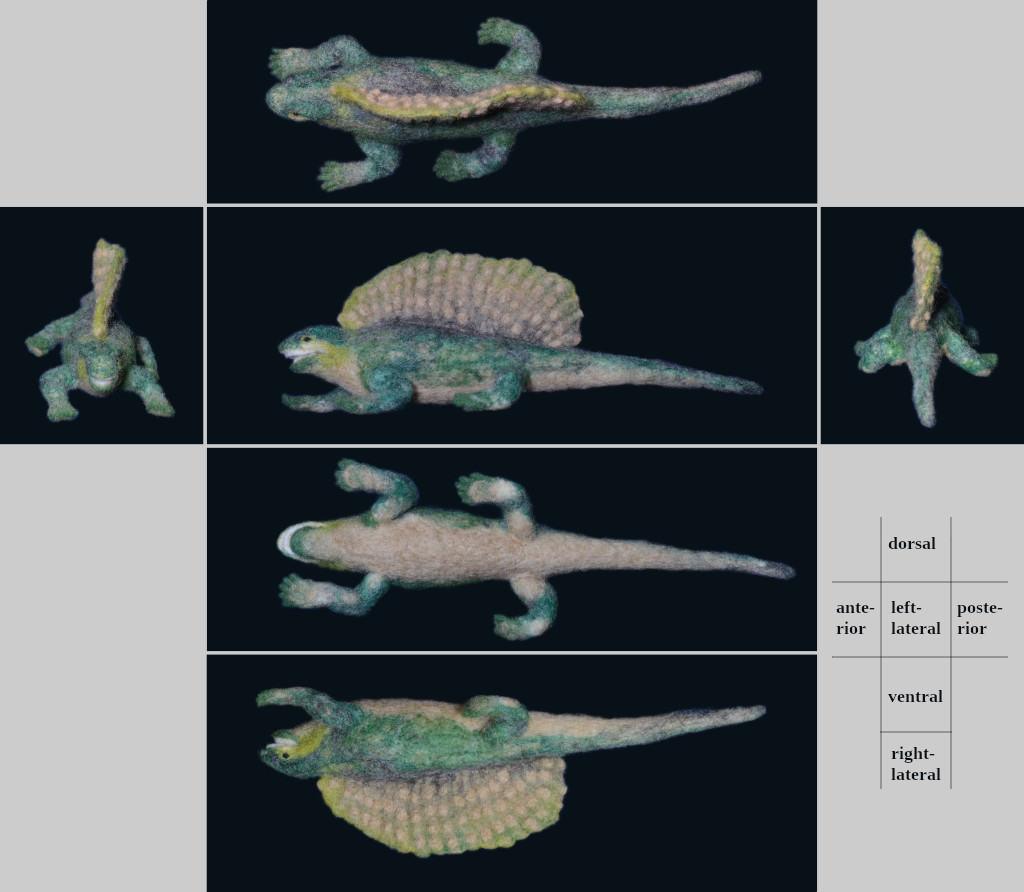
Making this model was referred to the TEXT-FIG.2 in Huttenlocker(2011) 3).
The illustrations of Late Paleozoic plant were referred to Gastaldo et al.(2024), Wang et al.(2012), and Sam Noble Museum (Oklahoma's Museum of Natural History) - Permian terrestrial communities -.
created in December 2023 - January 2026.
References:
- Agliano A, Sander PM (2020) Bone histology and microanatomy of Edaphosaurus and Dimetrodon (Amniota, Synapsida) vertebrae from the Lower Permian of Texas Anatomical Record 304(3):570-583. (DOI: 10.1002/ar.24468.)
- Angielczyk KD (2009) Dimetrodon Is Not a Dinosaur: Using Tree Thinking to Understand the Ancient Relatives of Mammals and their Evolution Evolution: Education and Outreach 2(2): 257-271. (DOI: 10.1007/s12052-009-0117-4.)
- Huttenlocker AK, Mazierski D, Reisz RR (2011) Comparative osteohistology of hyperelongate neural spines in the Edaphosauridae (Amniota: Synapsida) Palaeontology 54(3): 573-590. (DOI: 10.1111/j.1475-4983.2011.01047.x.)
- Sues HD, Reisz RR (1998) Origins and early evolution of herbivory in tetrapods [abstract] Trends in Ecology & Evolution 13(4): 141-145. (DOI:10.1016/S0169-5347(97)01257-3.) (The full-text was referred to ResearchGate.)